
Open play, without anybody reading out the queue
Post the night. Players reserve their own spot. The screen decides who is next.
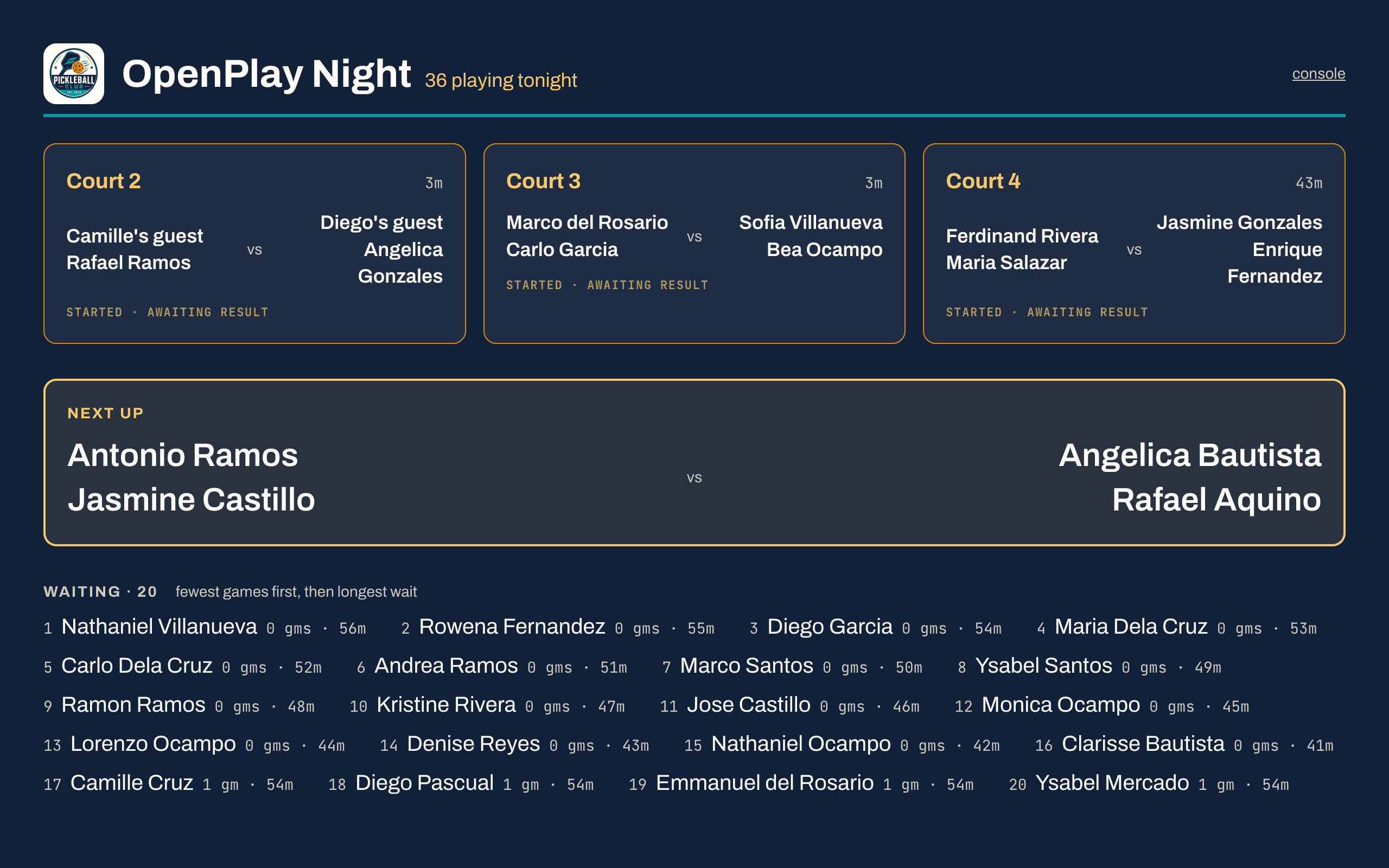
Every screen on this site is DinkDesk itself, running on our demo club — real software, not a real club's data.
The queue everybody can see
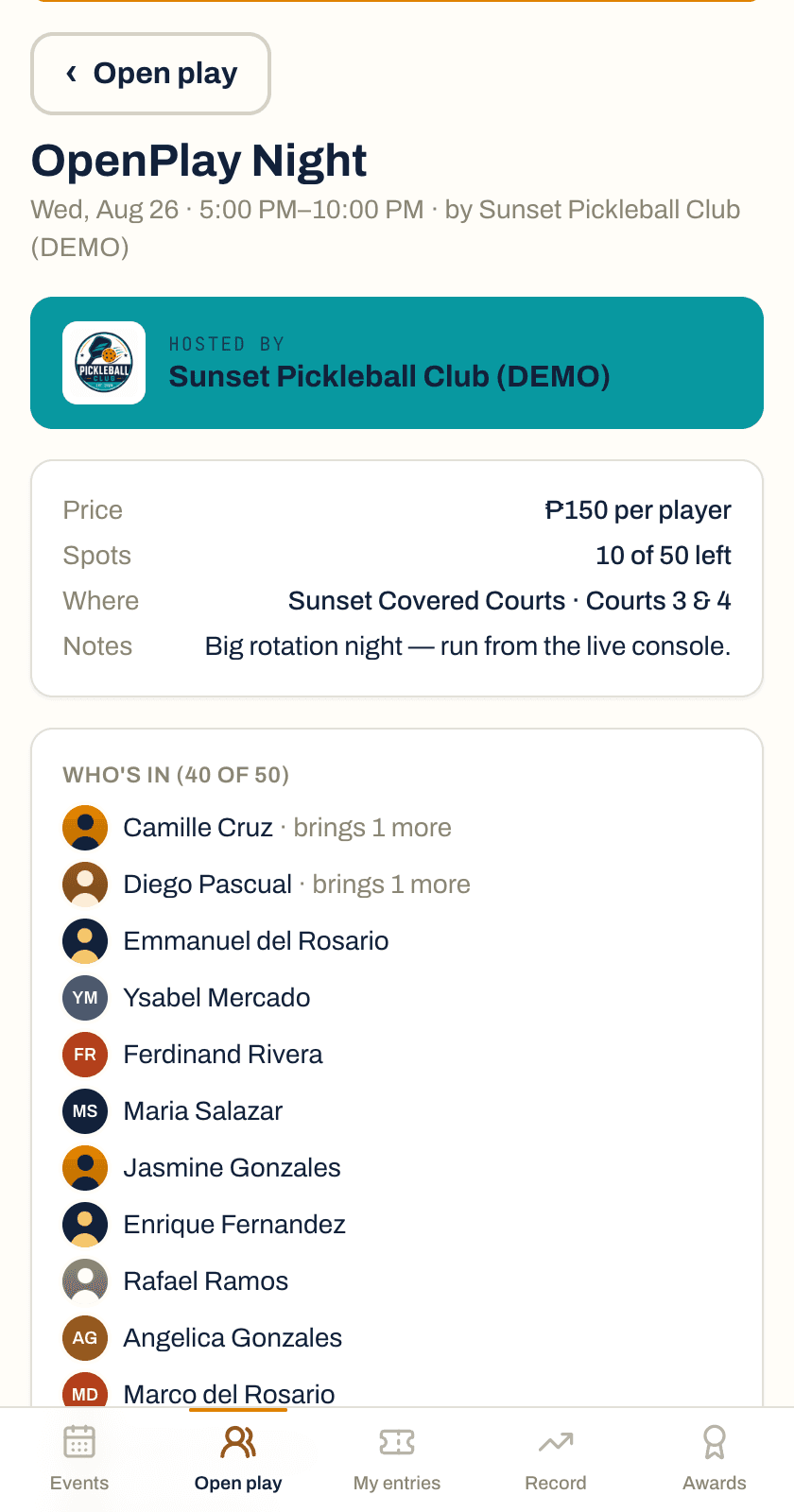
A session carries its date, price per head, capacity and skill level, and repeats weekly if it is a regular night. Players reserve from their phone and pay you directly; you scan their code at the door. Then the rotation screen pairs the next game itself, on the venue TV as well as at the counter.
Posting the night
- Date, start and end, price per player, capacity and skill level.
- A weekly repeat, for the night that is always on.
- It appears on the shared player board alongside every other club's, so your regulars' friends can find it.
- The session books real courts for the hours it runs, so nothing else can be booked over it.
Getting them in
- Players reserve their own spot and settle with you by GCash, Maya, bank transfer or cash — against your own accounts, with your QR shown to them.
- An unpaid hold expires after 24 hours, and never later than 48 hours before the session — so an unpaid spot comes back while there is still time to resell it. Reserve inside that last 48 hours and it is a flat two-hour pay-now clock instead.
- A waitlist that promotes itself when somebody drops.
- At the door you scan their code, or the counter walks them in and takes the money there.
- Letting somebody on for free takes your owner PIN and a reason tapped off a list, and the journal records who was let on and what was waived — so a favour is a decision with a name on it, not a gap in the takings.
- “Settling with the owner later” can actually happen: when they come back and pay, two taps on their row put the money in the night's takings and leave the comp on the record. Unsettled favours from earlier nights stay listed on the sheet, because by then their own night is closed.
- The player's phone says “On the house”, not a peso figure that reads like a bill.
The rotation
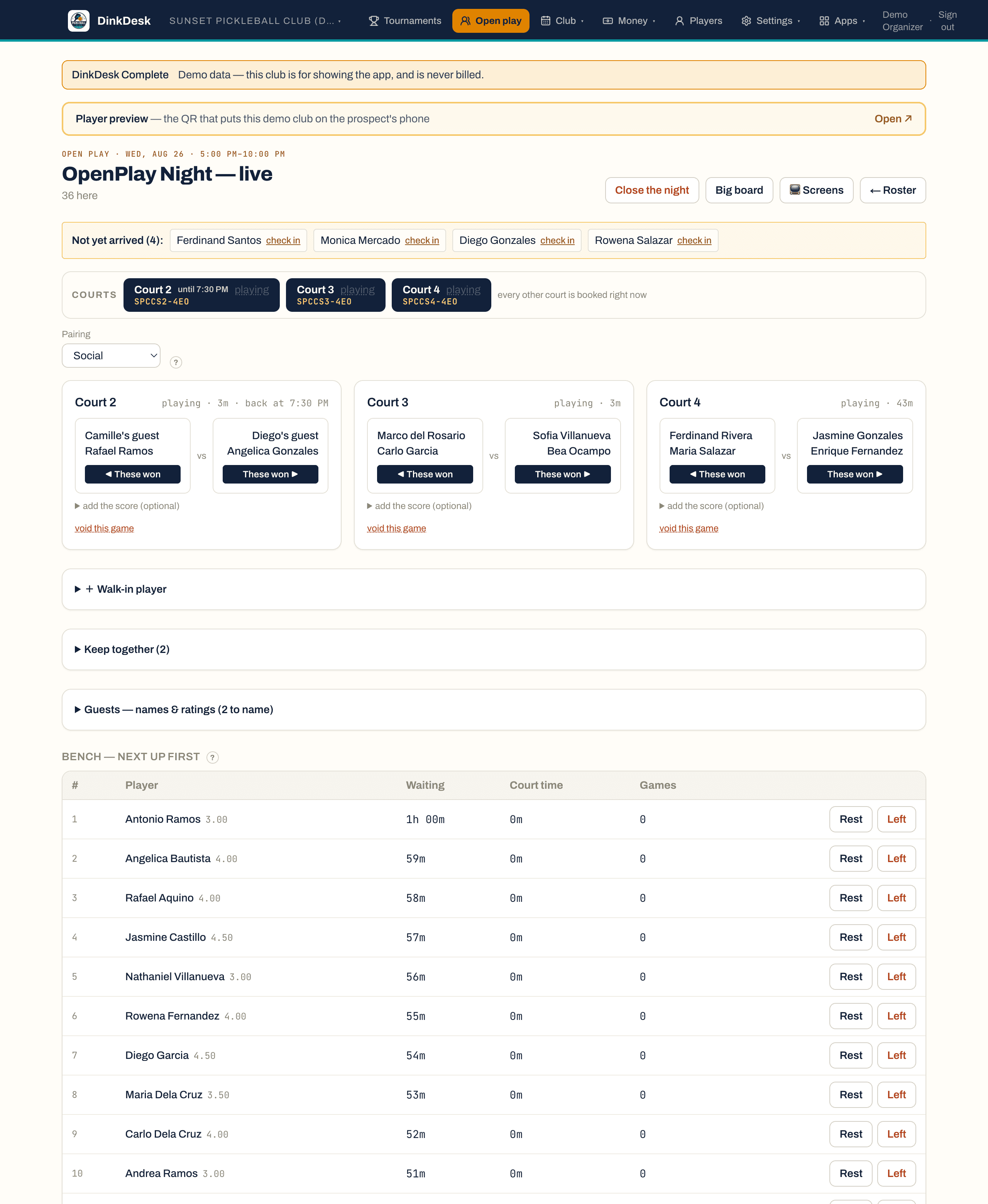
- The console pairs the next game for the courts the night actually booked.
- It weighs who has waited longest, who has played fewest games, and who has already partnered or played whom.
- Rated or purely social, your choice per session.
- Two pairs who want each other can ask for that game rather than wait for the draw.
- A tablet beside a court lets the players on it start their own game and say who won, without walking to the counter. It is paired once with a short code off a sticker and does those two things and nothing else — no check-in, no money, no deciding who is on.
The screen on the wall
- A full-screen board for the venue TV: courts in play, who is up next, and the waiting bench in order.
- The bench pages itself. A TV has no scrollbar and nobody to touch it, so on a thirty-strong night the board measures what fits and turns the page on its own — the people standing in front of it are not the ones whose names fell off the bottom.
- The same picture at the counter, where staff can override anything the pairing chose.
- Open play games are deliberately never rated — a social Thursday should not move anybody's number.
- Every address the night needs is listed on the console running it — the TV board, the code that pairs a courtside tablet, the page players open. Nobody hunts for a link when a stand goes blank at eight.
Ending it
- Closing the night is a button on the same tablet that ran it, not a job that waits for the owner's laptop.
- It refuses while anybody is still on a court, and names who — so a night cannot be closed out from under a live game.
- If somebody wants one more game after all, reopening is one tap, and the night comes back on the courts it can still have.
- A closed night keeps the hours it played. Only the unplayed tail goes back on the grid, so a rental cannot be sold into the half-hour the last game ran into.
- If your club shuts at 2am, half past midnight is still tonight. The desk list and the courtside tablets go on finding the night that is actually running, rather than turning over at a calendar midnight nobody in the building observes.
The four questions this always comes down to.
- Why would I pay for this when the group chat is free?
- The group chat is free at the point of posting and expensive at 7pm, when one person is holding a phone, a list and a pen, and the answer to “who's next?” lives in their head. This is that job, on a screen everybody can already see.
- My players will not download an app.
- There is nothing to download. It runs in the phone browser and can be added to the home screen. A player account is free and works at every club on DinkDesk, not just yours.
- People reserve and never pay.
- An unpaid hold expires on its own — after 24 hours, and never later than 48 hours before the session — so the spot returns to you while you can still sell it. Somebody reserving on the day gets two hours to pay, not a free seat. You are never chasing a name at 6pm.
- Do I have to run it exactly your way?
- No. The pairing is a suggestion on a screen; the counter can put anybody on any court. What it stops is the argument about whose turn it was.
It is one club, so these are one record.
The person who books a court is the person who buys a drink, joins Thursday's open play and enters September's tournament — without anybody typing a name twice.
Open play switches on when you run it, and off when you stop.
₱750 a month on top of DinkDesk Venue, or included in DinkDesk Complete at ₱2,999 with tournaments as well. Nothing here is bundled into a price you pay whether you use it or not.
Try it first: 2 rentable courts, the cashier and one complete tournament, free, for at least 30 days.